Why has Venezuela been a problem for the US? It’s not just the oil. It’s that Venezuela was a threat of a good example.
When I ran for state office as a Green Party candidate, I wanted desperately to show some hope, that things can turn around, in the areas of healthcare, education, housing, citizen participation, and more. I wanted to say “Look at what’s happening in Venezuela!”
But I couldn’t, because Venezuela had already been characterized as an evil dictatorship — by government officials and media across the political spectrum.
Even Bernie Sanders. In 2016, a fundraising mailer referred to Hugo Chávez as a “dead Communist dictator.” That was extremely disappointing — and ironic — because Chávez had actually accomplished in his country what Sanders claimed he wanted to do in the US. How in the world could people believe me, the only person they’d heard say Venezuela was a great example of hope?
Oil had been nationalized in 1976, 22 years before Hugo Chávez was elected president, beating out the 40-year-old agreement that resulted in the alternation in power between two political parties. (Sound familiar?)
What did Chávez do that put him on the wrong side of Washington and corporate America? He shared the oil profits with ordinary folks not just foreign oil companies and the small oligarchy, who had been reaping the rewards of having the largest oil reserves on the planet, while 70% of the population was in poverty.
The first acts of his presidency were to implement a literacy program modeled on the Cuban literacy program, to create a new constitution using a participatory, bottom-up, democratic process, and to install healthcare clinics in the barrios staffed by Cuban doctors. Venezuela and Cuba traded oil for doctors, who then helped train Venezuelan doctors. Education, participation, and healthcare empower people; they are not the acts of a dictator. Perfect? No. Dictator? No.
When you are on the wrong side of the most powerful nation — economically and militarily — that the world has ever known, there’s a checklist of accusations that citizens will hear, and likely believe: corruption, fraudulent elections, human rights abuses, suppression of a free press, crime, and drug trafficking. People could easily believe the bad, especially if the continent is South America, Africa or Asia. People did not hear about the good: the improvements in literacy, education, healthcare, housing, and participation in creating the laws of the land.
Hugo Chávez died at the age of 58 in 2013. Nicolás Maduro was elected. The accusations and interventions intensified.
In early 2015, Obama imposed sanctions on Venezuela and designated it an “unusual and extraordinary threat to the national security and foreign policy of the United States.” That was odd, since no one I knew was aware that Venezuela posed a threat to the security of the US. It was also odd, because just a few months earlier, in December 2014, Obama impressively presided over the most significant normalization of US-Cuba relations in over 50 years.
In 2016 Trump lost the popular vote but won the presidency, and right away he escalated the sanctions and the threat of military interventions.
The sanctions continued. To many people — me included at first — sanctions sounded like a slap on the wrist, much better than a military intervention. Sanctions are in fact “unilateral coercive measures” prohibited by the United Nations charter. Sanctions are acts of war and as lethal as war, with tens of thousands of Venezuelans dying because of the sanctions and many more leaving the country so that their families can eat, and survive.
In the wake of 2019 sanctions, oil export revenues plummeted from $4.826 billion in 2018 to just $477 million in 2020. Imagine living on $5,000 a month, and then trying to survive on $500 a month.
In 2019, Trump declared Venezuelan elections illegitimate, and instead of recognizing Maduro, he recognized Juan Guaidó as president, despite the fact that Guaidó had never run for president, and a majority of Venezuelans did not know his name.
And yet, against all odds, Venezuela was recovering. However, the attacks escalated.
On January 3, 2026, the US used a highly sophisticated — and of course outrageously expensive — military attack to kidnap a head-of-state and his wife and imprison them. Trump immediately dropped his focus on the verifiably false charge of drug-trafficking and focused on how well he could run the oil companies, which he had played a big part in sanctioning almost to death.
Now the interim president Delcy Rodríguez is making decisions for her country with a gun to her head. Long-term observers of Venezuelan politics emphasize that none of us can know all the factors that go into the decisions that she is making on behalf of Venezuela for the short and long run. With a big gun to her head.
* * * * *
As always, I was trying for this to be shorter. As it is, I left a lot out! For more information, below are some links, a couple of English-language Venezuelan and Latin American news sources, and some pieces I’ve written over the years, including one on Hugo Chávez.
venezuelanalysis.com
orinocotribune.com
resumen-english.org
gp.org/why_i_am_going_to_venezuela
laurawells.org/hugo-chavez-ten-years-presente
laurawells.org/category/venezuela
Good luck to all of us.
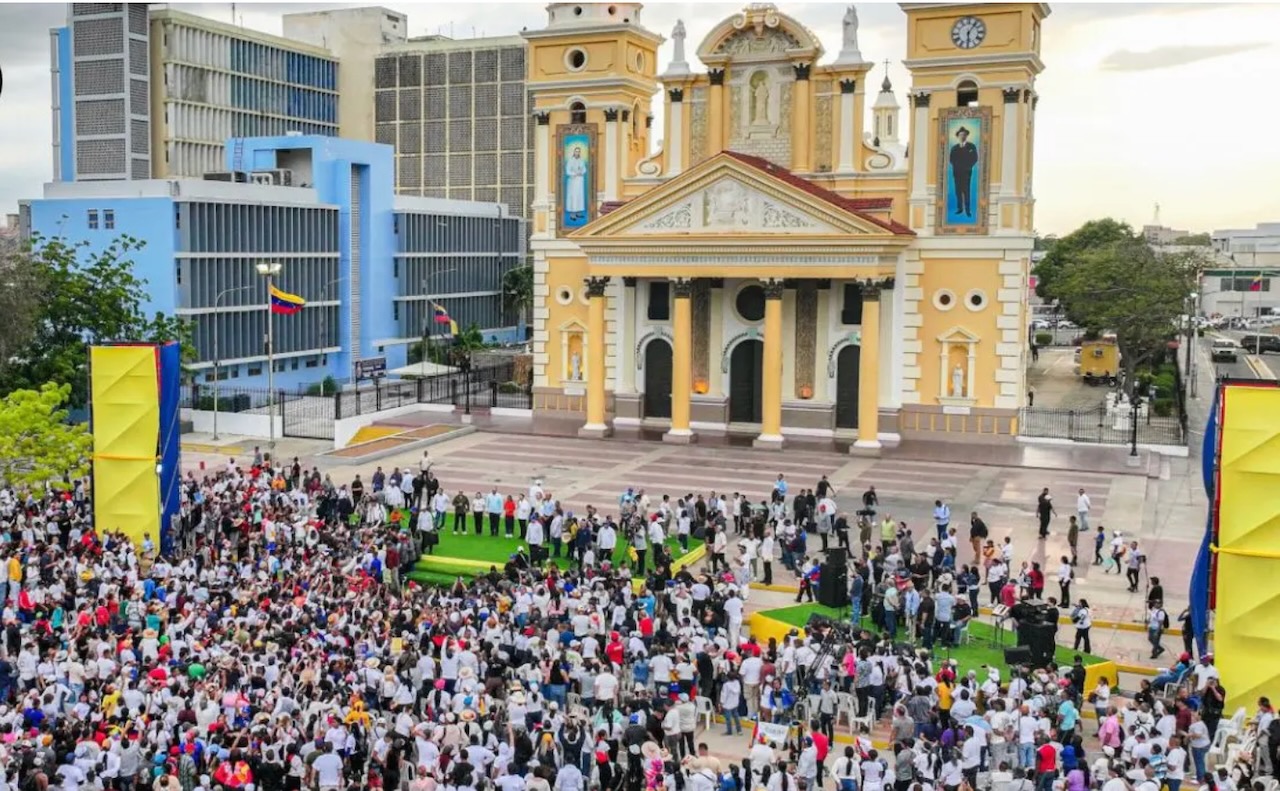
Photo of rally opposing sanctions – venezuelanalysis.com